How To Master Architectural Photography
As photographers, we draw our inspiration from the world around us. With many of us living near or making our way into bustling cities daily, it is easy for us to be drawn to architecture and use this as our muse.
Although the subject matter may be plentiful, architectural photography requires a specific set of skills for us to master, from knowing what camera settings to use for architectural photography, to selecting the right kit of lenses and camera accessories. In the following blog we will take you through all you need to know to start doing the manmade structures around you justice with your new and improved architectural photography practice.
- What is architectural photography?
- How to get started in architectural photography
- Use vertical lines to your advantage
- Use a tripod for the best architectural photography
- What lens to use for architectural photography
- Work with perspective
- Light is an architectural photographer's best assistant
- Plan your architectural photography shoots for the right time of day
- The mirrors edge
- What camera settings to use for architectural photography?
What is architectural photography?


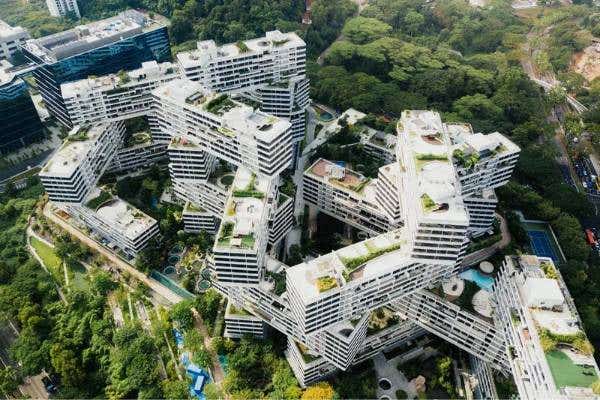
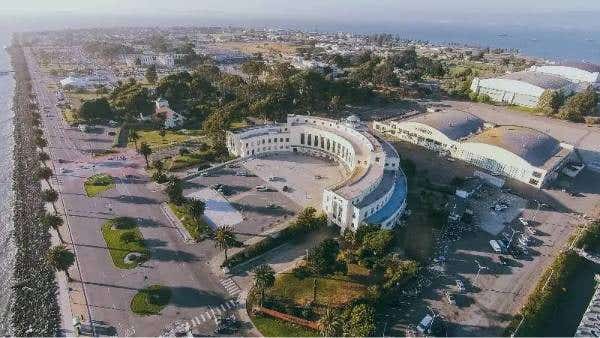
It's much easier to master any photographic format if you have a firm grasp on what exactly it entails. Just as landscape photography involves photographing the land, architectural photography involves photographing the architecture. This architecture most commonly refers to buildings, but it can also be extended to include any manmade design or structure.
How to get started in architectural photography
Having some experience with other forms of photography, particularly landscape photography will be a real bonus if you are photographing architecture for the first time.
Environmental factors, cloud formations and the direction of the sun can all play a huge factor in the outcome of your images and it’s worthwhile scheduling your shoots for appropriate times once you have developed a bit of an understanding.
Just as importantly, the skills you have obtained through landscape, travel and conceptual photography practice can all be utilised in your first architectural trials. Firstly, it is good to understand photographic composition and how you can use this understanding to your advantage.


Use vertical lines to your advantage


One composition technique to take note of when photographing architecture revolves around the vertical lines within your image. With any art form, rules are made to be broken, or at least bent but one mainstay of Architectural photography is to ‘keep vertical lines vertical’.
Your camera lens will inherently distort perspectives, slanting vertical lines inwards from the front of your subject, until they converge beyond your frame. These distortions can be used to your advantage when capturing more dramatic shots, or when taking cleaner more structurally based pictures.
When focussing on a structural object use any geometrical patterns to your advantage, aiding to engage your viewer’s eye.
Use a tripod for the best architectural photography
Architectural photography, perhaps more than any other type of photography, involves an understanding of balance and symmetry.
It is important to have a focal plane which is perpendicular to vertical lines and vertical lines which are straight, which we have touched on earlier. The easiest and most effective way to keep these things in check is with the use of a tripod, which helps you keep the camera level and parallel to the horizon.
As well as this technical advantage, tripods are also essential for capturing steady shots which are sharp and free from noise, thanks to the ability to shoot at longer shutter speeds and avoid raising the ISO setting. We'll delve into the best camera settings needed for architectural photography in more detail below.


If you are not sure where to start when it comes to purchasing a tripod, take a look at our handy tripod buying guide.
What lens to use for architectural photography


As with any form of photography, having the right lens on your camera won’t instantly make you a better architectural photographer, but it can definitely help you along your way.
As there are many different styles of architectural photography you may want to capture which may involve structures of varying shapes and sizes, there is no one lens solution. To counteract this we will take you through some popular options and the benefits of each.
Wide-angle lenses - A wide-angle lens will allow you to fit larger structures within your frame with greater success. These lenses are also the best choice for interior shooting, while their inherent nature of distorting features can be a pro or a con, depending on your desired outcome.
Standard zoom lenses - A standard zoom lens will produce less distortion than a wide angle lens, but if you are photographing a larger building, you may struggle to fit it all in with one of these lenses. They are a great choice if you are focussing on particular details and not the building as a whole.
Tilt-shift lenses - Quite simply, if you are serious about photographing architecture, you must try a tilt-shift lens at least once. Tilt-shift lenses allow you to adjust the optics of the lens in order to keep your building straight without moving the camera, thus reducing the appearance of skewed vertical lines.
Browse some architecture-friendly lenses
Work with perspective
The key to an above-average architectural shoot is obtaining a fresh and interesting perspective of your subject.
Shooting from street level can often lead to boring and flat images. Don’t be afraid to move around a little to adjust your perspective and shooting angle. We have discussed the benefits of low-angle photography previously, while a higher vantage point, longer distance, or other adjustments can be equally successful.
If you are within close proximity to your subject, try to adjust your vantage point by focusing on its individual features, as opposed to the structure as a whole - this can save you from having a whole memory card full of images that are too similar.


Part of the appeal of architectural photography is capturing a new perspective on a familiar subject. By experimenting and developing your own unique style early, you are giving yourself every chance of creating a distinctive portfolio that stands out from the crowd.
Light is an architectural photographer's best assistant


Natural light is your friend but you also have to learn to use it wisely. Front and backlighting are best to be avoided, as it can reduce details and lead to flat subjects, or leave important aspects of your structures steeped in shadow.
With the ideal light at about a 45-degree angle to your subject (side-front), you can generally use whatever shadow is created to your advantage, by adding dimension to your image. You will also find surface details popping and an overall character boost to your images.
Plan your architectural photography shoots for the right time of day
It can be frustrating as you are keen to get out there shooting, but you will quickly learn that there are appropriate times to shoot and schedule your shoots accordingly if you want to develop a portfolio full of successful images.
As a general rule, sunny and clear days will give you plenty of bright light to illuminate your images, adding contrast to your compositions. The golden hour, a friend to all outdoor photographers, is the period just before sunset or after sunrise. This is your prime time for shooting, taking advantage of the warm golden colours, deep shadows and an overall mood that lends itself to imagery.


The mirrors edge


It is important to survey any scene and make adjustments accordingly, being mindful of any factors which can affect your images. One aspect which can be particularly detrimental to architectural photographers is reflective surfaces, such as glass in buildings, cars, storefronts and signs.
Although it is often unavoidable to completely remove these objects from your frame, be mindful of their positioning and their effect on your image, as there is nothing worse than noticing them later when you are in the process of editing.
Many photographers have success limiting the appearance of reflections by using circular polarising filters on their lens. This may not remove the reflections completely, but it can limit them so they are less distracting.
What camera settings to use for architectural photography?
For architectural photography, the primary goal is to achieve maximum sharpness and detail across the entire structure, which dictates the following key camera settings:
-
Aperture (Depth of Field):
-
Aim for a mid-range aperture, typically f/8 to f/11.
-
This range is the "sweet spot" for most lenses, ensuring maximum image sharpness across the entire frame (from foreground to background).
-
-
ISO (Sensor Sensitivity):
-
Keep the ISO as low as possible, ideally ISO 100 or ISO 200.
-
A low ISO minimises digital noise and maximises image detail and clarity.
-


-
Shutter Speed (Exposure Time):
-
Adjust the shutter speed to achieve the correct overall exposure after setting your aperture and ISO.
-
Since your subject is static, slower speeds are acceptable, but they require a tripod to prevent camera shake.
-
Stability and Bracketing:
-
A tripod is essential due to the typically slow shutter speeds needed for optimal aperture and ISO settings.
-
Use Exposure Bracketing (taking multiple shots at different exposures, e.g., −2,0,+2 EV) in high-contrast scenes to capture detail in both shadows and highlights for later HDR processing.
Improve your photography practice with Ted’s
Architecture has long been a favoured subject of artists from all mediums, not just photographers. As a subject, architecture allows our most significant man-made structures to be inspected and admired, and more importantly their status in the natural world to be discussed.
Whether you want to improve your architectural photography, or your portraits and landscapes require the most attention, Ted’s photography blog should be your regular stop for the latest hints and tips, product roundups and more.


Next Post
Essential Lighting for YouTube: Your Guide to Professional Video Lighting
Previous Post
Fujifilm Mirrorless Camera Roundup - 2025